- The Modern Day Sex Talks with Kathleen Hema
- Posts
- We're TOO Focused on Consent
We're TOO Focused on Consent
Stop saying, "May I give you a hug?" when greeting kids and do this instead⤵️

Kathleen Hema
November 27, 2025
It’s Time to Hit Pause on Consent
Have you been on your way to your parent’s house and text your mom, “Hey - Just a reminder! Ask Suzy for a hug instead of just pulling her in for a hug.”
I get it! I’m a mom and I’ve done this too. We all want our kids to feel safe and comfortable around family and friends. That’s why we send these reminders to our family and teach our kids about consent.
But I would love it if you tried something new!
Instead of telling your parents to ask your kid for a hug or kiss, instead text them this, “Our ETA is 12:45. Just a reminder, when you see Suzy, ask her how she likes to say hello and then follow her lead. We’ve been teaching her how to greet others so that she upholds her body boundaries.”
Does it sound more doable? Maybe your mom feels helpful that she can contribute to Suzy’s skill-building?
Lately, I’ve been focused on not using the word consent with my kids. Because from a sex ed perspective, kids cannot consent. This is for their safety and protection yet as parents we will ask them, “May I give you a kiss?” “May I hold your hand?” These questions are a good start to developing bodily autonomy but they’re based off of a consent concept.
Consent being the affirmative agreement to respect one’s bodily autonomy by agreeing to do something that aligns with their body boundaries. ←This is really important! What are our kid’s body boundaries? I hadn’t fully explained to my own kids what a body boundary was because even I became too focused on consent.
When kids don’t see certain family members often, even though we may have a familiar connection to them, our kids don’t. They’re essentially a stranger. And these family members may be completely on board with respecting your wishes to use consent language yet it’s intimidating to a child to have an adult stranger say, “May I give you a hug and kiss?”
A kid may feel uncomfortable and still say yes because they think that is the “right” thing to do. Or they may say nothing at all and hide behind you. Then you start telling them, “Aunty Leeann just asked you a question, please give her a response.” The child’s body language isn’t expressing confidence or comfort. They look like they feel unsafe in the interaction.
So instead of focusing on asking kids if we can give them a cuddle, kiss, or hug, let’s share our body boundaries and help them to express their body boundaries. For example, I told my kids that we will be seeing a lot of family this holiday and that there will be some adults that they don’t know and some they do. Then I explained how I plan to greet those adults. I said, “I feel safe and comfortable giving adults I don’t know a handshake. This is my body boundary. But with adults I do know, I feel comfortable giving them a hug but not kisses. My body boundaries are different depending on the situation and who I know or don’t know. What about you?” turning to my husband and asking him to share.
After he shared his body boundaries, I said to my kids, “What body boundaries would you like to put in place for yourself in order to make sure you feel safe and comfortable greeting adults?”
This whole conversation took less than 5 minutes and it’s been something I’ve checked in on with them just before a gathering. One evening we went over to my cousin’s house and my kids felt prepared to greet everybody. That’s when my cousin went to give my youngest a hug when she said, “I prefer handshakes” while putting out her hand! I don’t think she would’ve said that if we hadn’t practiced developing our body boundaries for greeting adults.
We all have bodily autonomy and many kids may not know how to assert their bodily autonomy. Rather than using the word consent, try sharing your body boundaries and why you’ve set those boundaries. Tell your kid why you prefer to greet someone the way you do which is simply because that body boundary makes you feel safe and comfortable.
That’s the goal, right? We all want our kids to feel safe and comfortable at all times. Let’s build up their skills for setting their body boundaries. And don’t worry - you’ll still get to use the word consent in the near future!
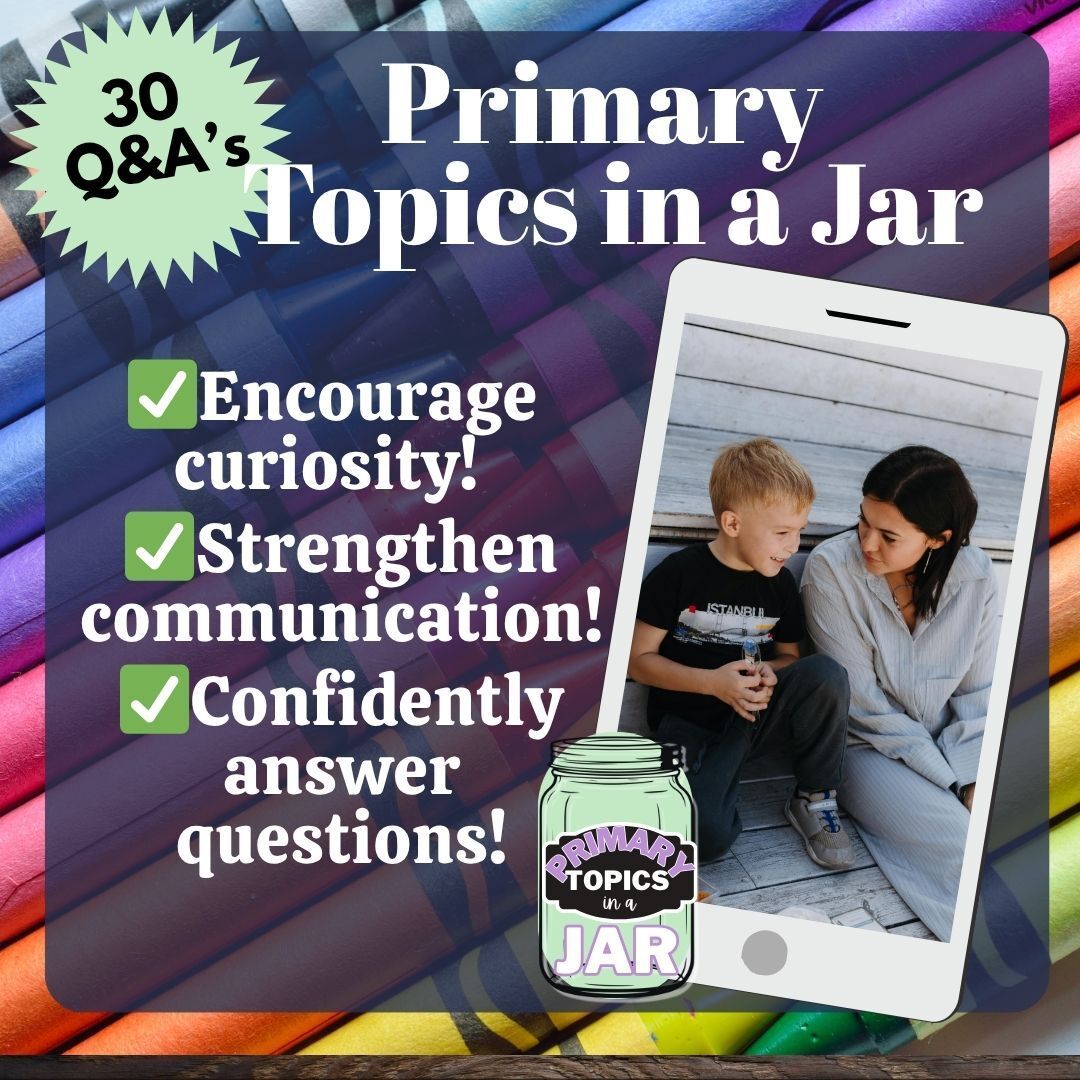
What is Primary Topics in a Jar?
Primary Topics in a Jar is a question and answer-style activity designed for your Primary age child between the ages of 5 and 7 years-old. It was modeled after my most popular digital download, the Puberty Topics in a Jar.
If you have a child between the ages of 5 and 7 years-old and want to begin having the talks about reproduction, gender, body parts, and social and emotional skill building then this is the activity you need!
✅It’s 30 questions with answers that allow you to build your confidence to age-appropriately start talking about sex, sexuality, and sexual health. And because you’re starting in the Primary age, you won’t be saying the word sex!
Whether you’ve had zero talks about Where Babies Come From, defining a public versus private space, and developing bodily autonomy or you’ve been leading the talks since your kid was 4 years-old, you will find this activity taps into your kid’s curiosity.
When I introduced this activity to my almost 7 year-old, she was eager to get started. After doing one question she asked if we could do another and then said that she wanted to go through all 30 questions that night! 😅
This activity can help you if you’ve got 3 minutes a day and you’re:
struggling to say medically-accurate terms in front of your child.
having difficulty finding the right words to explain reproduction.
unsure what talks are appropriate at this age.
looking to encourage your child to ask you their questions.
trying to strengthen the lines of communication between you and your child.
Primary Topics in a Jar is an easy way to pro-actively prepare yourself for the talks coming up in the Intermediate age.
Where can I find Primary Topics in a Jar?
On December 1, 2025 it will ONLY be available inside The Complete Guide to the Early Talks! If you have already purchased the Guide to the Early Talks - you’ve already got it! Just log-in to your account and download it today!
But for this week only, you can get Primary Topics in a Jar without having to purchase the Complete Guide to the Early Talks.
From Today until November 30, 2025 you can get Primary Topics in a Jar for just $1 per question!
Don’t Make This COMMON Parenting Mistake!
Parents don’t fall into this trap! It’s EASILY avoidable!

Top Talks has ALL 3 Topics in a Jar Activities!
If you’ve got kids across the Primary, Intermediate, and Middle School age ranges - you can easily find all 3 Topics in a Jar activities inside Top Talks.
Top Talks is for parents who want to have the following sex talks with kid aged 7+:
The Where do Babies Come From Talk
The Sex Talk
The Puberty Talk
The Relationships Talk
The Masturbation Talk
The Online Safety Talk
The Porn Talk
& now Top Talks includes the Primary, Puberty, and Teen Topics in a Jar activities!
All 90 Q&A’s to help you age-appropriately have the sex talks!
Learn more about Top Talks Unlimited Access or 35 Day Access inside this FREE preview lesson.
Top Talks is being updated with new lessons! You can get Top Talks: Unlimited Access today for the current price and then receive all the new updates for FREE when they’re released in 2026!