- The Modern Day Sex Talks with Kathleen Hema
- Posts
- Is it ever OK for kids to use curse words?
Is it ever OK for kids to use curse words?
Here's how I used the Top Talks approach to explain curse words

Kathleen Hema
March 19, 2026
In partnership with

Every headline satisfies an opinion. Except ours.

Remember when the news was about what happened, not how to feel about it? 1440's Daily Digest is bringing that back. Every morning, they sift through 100+ sources to deliver a concise, unbiased briefing — no pundits, no paywalls, no politics. Just the facts, all in five minutes. For free.
Thank you to 1440 Media for sponsoring today’s newsletter! It’s been helpful to receive daily news updates regarding all the things happening around the world every morning! If you haven’t subscribed to 1440 Media - check it out and see how you like their daily news only emails!
Bad words? Dirty words? Naughty words? Grown-up words? What do you call ‘em?
Most kids realize that some words will elicit a reaction from the adults around them - and this observation can be made by kids as early as 2 or 3 years old. You’ve seen those videos on IG of toddlers cursing - (usually in context!) and the parents are struggling not to laugh. The common reaction of parents is to begin filming or laughing when it happens, which can make a kid feel more inclined to use the word(s) more often!
As kids get older, the humor of a child saying a curse word fades and a conversation about what that word means and why it’s not appropriate for a child to say will take place. I had this convo with my own kids recently and I approached it using the same strategy that I use inside Top Talks for the sex, masturbation, and porn talk.
First, I didn’t say the words were ‘Bad Words’
I don’t use the word ‘bad’ when describing things around my kids. For example instead of saying, “the food tastes bad” or “that’s a bad movie” - I aim to more accurately describe it, “the food tastes sour” or “the plot of that movie is confusing.”
This shift from using the term “bad” as a catch-all has helped me to be more intentional when describing things I don’t prefer. This practice came in handy the other day when my kid said, “shit.” I didn’t look up at her surprised or immediately gasp when she said it.
I know I have said that word in front of my kids when I dropped my phone as well as when I spilled my coffee. My daughter had just picked up her pencil case of over 100 colored pencils but didn’t know it was open. While the cascade of colors poured onto the floor, she shared her frustration by saying “shit.” It was perfectly in context to how I’ve used the word in the past, but it was still shocking to hear my little one say a curse word.
As I helped her to pick up the colored pencils, I explained that the word “shit” is considered a curse word. Curse words are used by adults to describe negative or unfortunate situations, like all 100 pencils falling out of the pencil case! Some adults will say “shit” is a “bad word” but the word is not bad nor good, it’s just a strong word that adults often use to show a strong emotion. Although, saying “shit” after all the colored pencils fell out of the bag was an accurate use of the word, I explained that it’s not appropriate for children to use because it’s considered a curse word.
Second, explaining that some adults don’t use curse words
“What are the other curse words?” was the question she immediately asked which I thought was a great question in order to better understand the language used by adults versus children. I asked her which words has she heard that she would classify as curse words. She rattled off the following list, “dammit, stupid, crap.” We talked about how saying these words sound stronger than saying, “Oh no, darn it, shoots.”
“If I accidentally say a curse word at school, will I get in trouble?” This question is spot on for a 7 year-old to ask! It aligns with how they process right from wrong. I explained that some adults find curse words inappropriate to say at all times, even if said by adults. While other adults find curse words to be only be inappropriate in certain situations. So it’s difficult to say with certainty that you would or would not get in trouble if your teacher heard you use a curse word. Most likely, a teacher would be surprised to hear a child say a curse word and tell the child that curse words are inappropriate to use at school. So, it’s best to avoid saying curse words at all and use words like “darn it or shoots” instead.
Even adults are urged not to use curse words all the time, especially when around children. Some adults tell other adults to, “watch your language” if they hear an adult using a curse word in front of children. So, while curse words are common words that everybody knows, there is no agreement amongst everybody on when it’s completely appropriate to use. Yet, most adults will say that children shouldn’t be using curse words and will tell children to use other words to describe their emotions.
In my opinion, curse words can add emphasis to a story because of the strong association of the words. And curse words have a time and place where using them just fits the situation better than other words. I don’t use curse words every day and I am mindful that some adults prefer to never use curse words so I try to limit my use of these words when in public. Therefore, I encourage my kids to avoid using curse words for right now and learn other ways to verbally express their strong emotions.
Like with my approach to the sex talks, my goal for this talk with my 7 year-old was to give my kid the factual information, in an age-appropriate way, and then share my family values. My intention wasn’t to tell her to never say a curse word. Instead the goal was to give her the information to age-appropriately understand why certain words have a stronger meaning than others and how using curse words as a child can affect how others view you.
This whole talk took less than a couple of minutes to have. There was no scolding, no soap was used to wash out a mouth, and no child was made to feel bad about themselves for using a curse word.
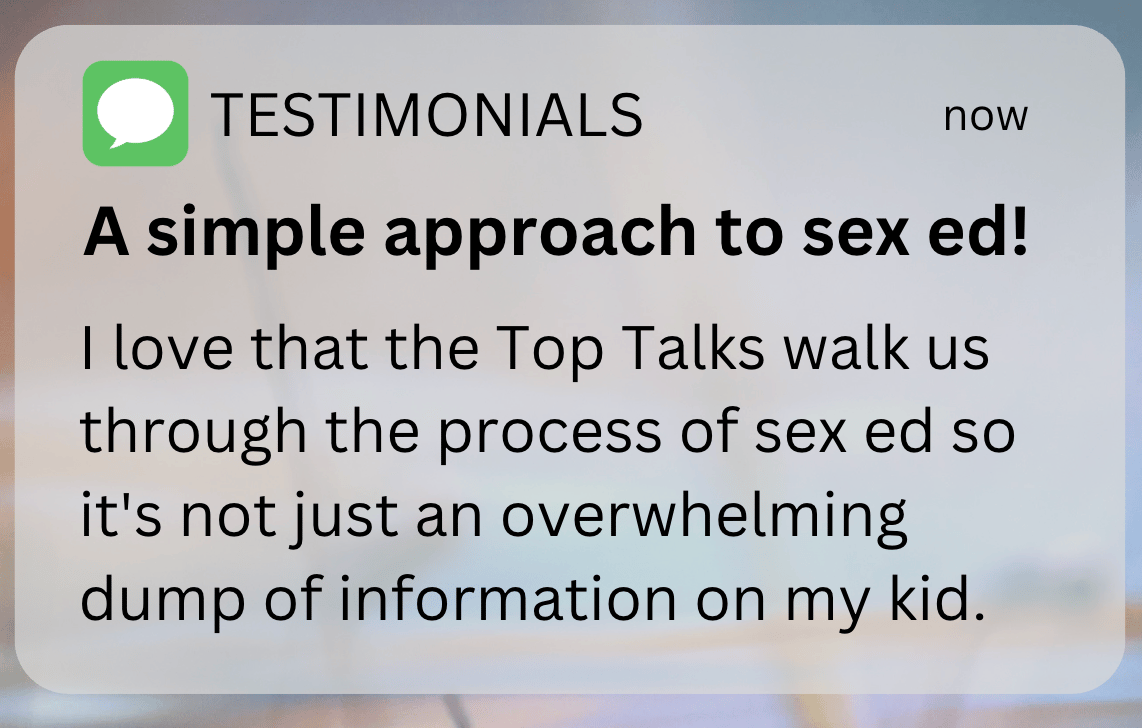
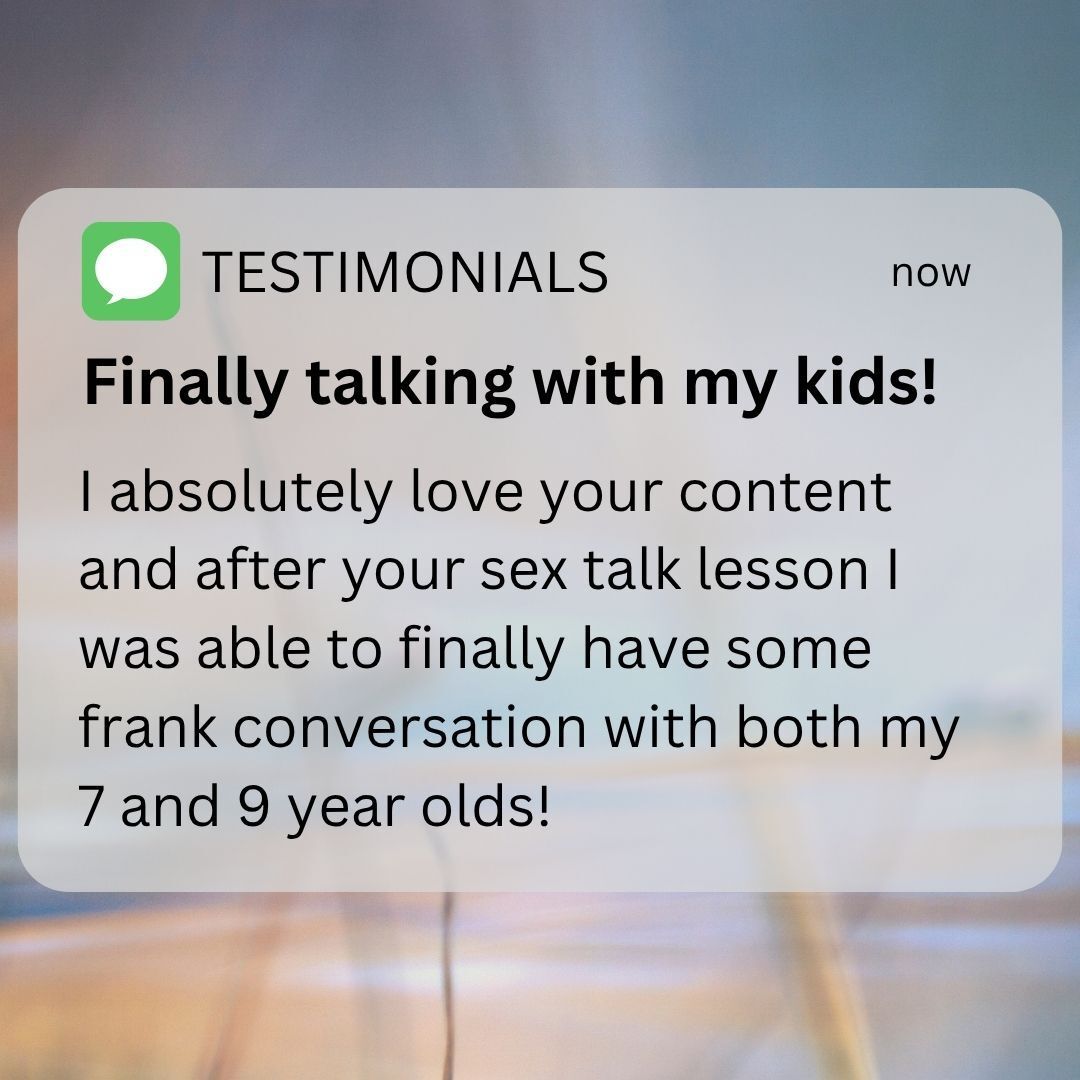
Since that talk, we’ve gone on to talk about more words like “hell, the f-word, and idiot.” It’s been an ongoing conversation now, similar to other sex talks where information is layered upon each other building to a better understanding of a basic concept. Using a layered approach to discuss complex topics is how I teach parents to have the sex talks inside Top Talks. Check out a free preview of Top Talks here to learn more! And JOIN the hundreds of parents from 40 states and 14 countries who are having Top Talks! Here’s what parents have to say about it ⤵️
 |  |
Should I explain how a baby is born to my 4 year-old?
Short answer: Yes
Long answer: ⤵️

Unsure how to layer the Early Talks for your 4, 5, or 6 year-old? Download the Complete Guide to the Early Talks (*includes Primary Topics in a Jar!)⤵️
Confidence & readiness to answer the question Where do Babies Come From? doesn’t happen overnight! Start learning how to answer this question so you’re ready when your little one eventually asks it one day with the Complete Guide to the Early Talks.

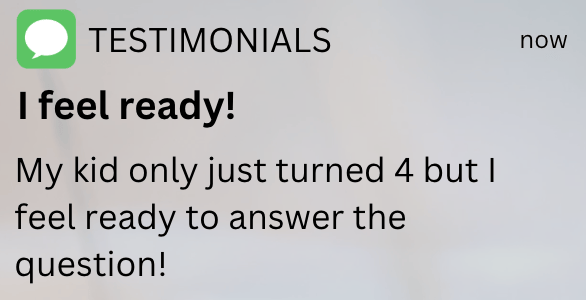
Here’s what parents have to say ⤵️:
 |  |
Thank you for being here & getting prepared to answer your kid’s sex questions!
If you haven’t grabbed my free starter pack - What are you waiting for?
If you’ve got a question or topic that you’d like to see discussed here next week, simply reply to this email!
💕Kathleen